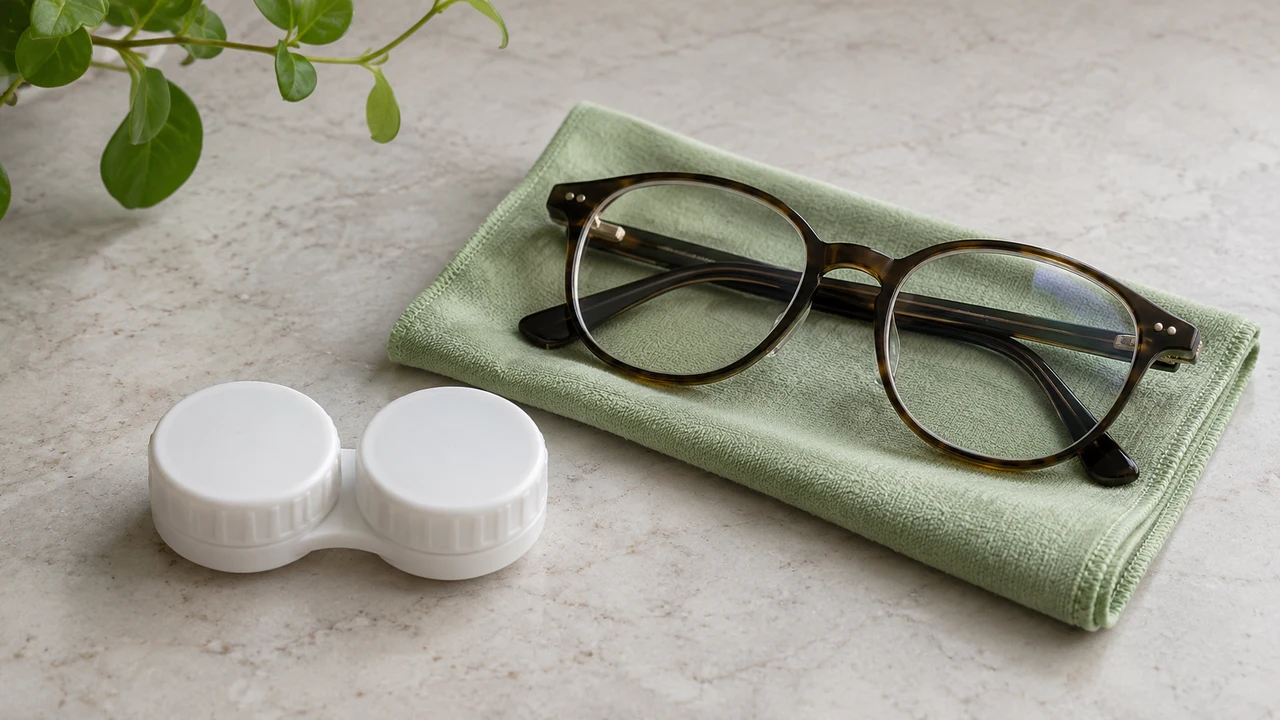
The small case beside a contact-lens bottle deserves attention each time it is used. Replacing its contents is only one part of care. Current CDC and National Eye Institute guidance includes cleaning the case with appropriate solution, drying it, leaving it open in the recommended position and replacing it regularly. Keep those tasks with the instructions for your actual prescribed lenses and care system rather than treating a tidy-looking case as evidence of cleanliness.
First identify the system you actually use
The National Eye Institute describes the ordinary multipurpose-solution routine and also notes that some people use different care systems. This guide concerns that ordinary case routine; it is not an instruction for a hydrogen-peroxide neutralizing case or permission to substitute one system's parts for another. Ask your eye-care provider which system and compatible supplies are appropriate.
Wash and dry your hands as directed before handling the lenses or case. Keep the actual product instructions available, including any more specific case-care or replacement requirements. Single-use lenses are not made reusable by owning a case. A household travel organizer should preserve the correct supplies rather than combine unidentified bottles and cases into a generic kit.
After putting the lenses in, care for the empty case
For the routine it describes, NEI says to rub and rinse the case with fresh contact-lens solution, discard that solution and dry the case with a clean tissue. It then says to store the case upside down on a clean tissue with the caps off. CDC likewise specifies rubbing and rinsing with solution and upside-down, caps-off storage after use.
Use the recommended lens-care solution, not drinking water, saliva or a household cleaning mixture. Do not mix old solution with fresh solution. These instructions are not a recipe for making a disinfectant or a claim that an improvised alternative becomes suitable after boiling or filtering. Follow the actual product and professional directions for lens storage separately from drying the empty case.
Put replacement beside the daily habit
Both sources say to replace the case at least once every three months. Keep the start date or planned replacement with the ordinary supply note so the small object does not become invisible through familiarity. Follow any earlier replacement requirement applying to the actual system rather than use a general interval to extend it.
An original household note can be short: prescribed system identified; fresh compatible supplies available; empty-case cleaning and drying understood; replacement date recorded. It is a memory aid, not a record that the case has passed a microbiological test. A decorative container or premium travel pouch does not establish compatibility or replace those instructions.
Leave eye concerns with an eye-care professional
CDC advises removing lenses and contacting an eye-care provider if discomfort occurs. Do not use this ordinary routine as treatment for a painful or irritated eye, or as permission to continue wearing lenses while deciding whether symptoms matter. Keep backup glasses with a current prescription available as CDC recommends.
Before buying another case, confirm what the prescribed system requires and what replacement supplies are supported. The useful purchase is the correct compatible item, accompanied by a routine you understand. No brand, disinfection result, individual suitability or infection-free outcome has been tested or guaranteed by this article.
Sources & further reading
Published sources for the details and examples discussed in this story.