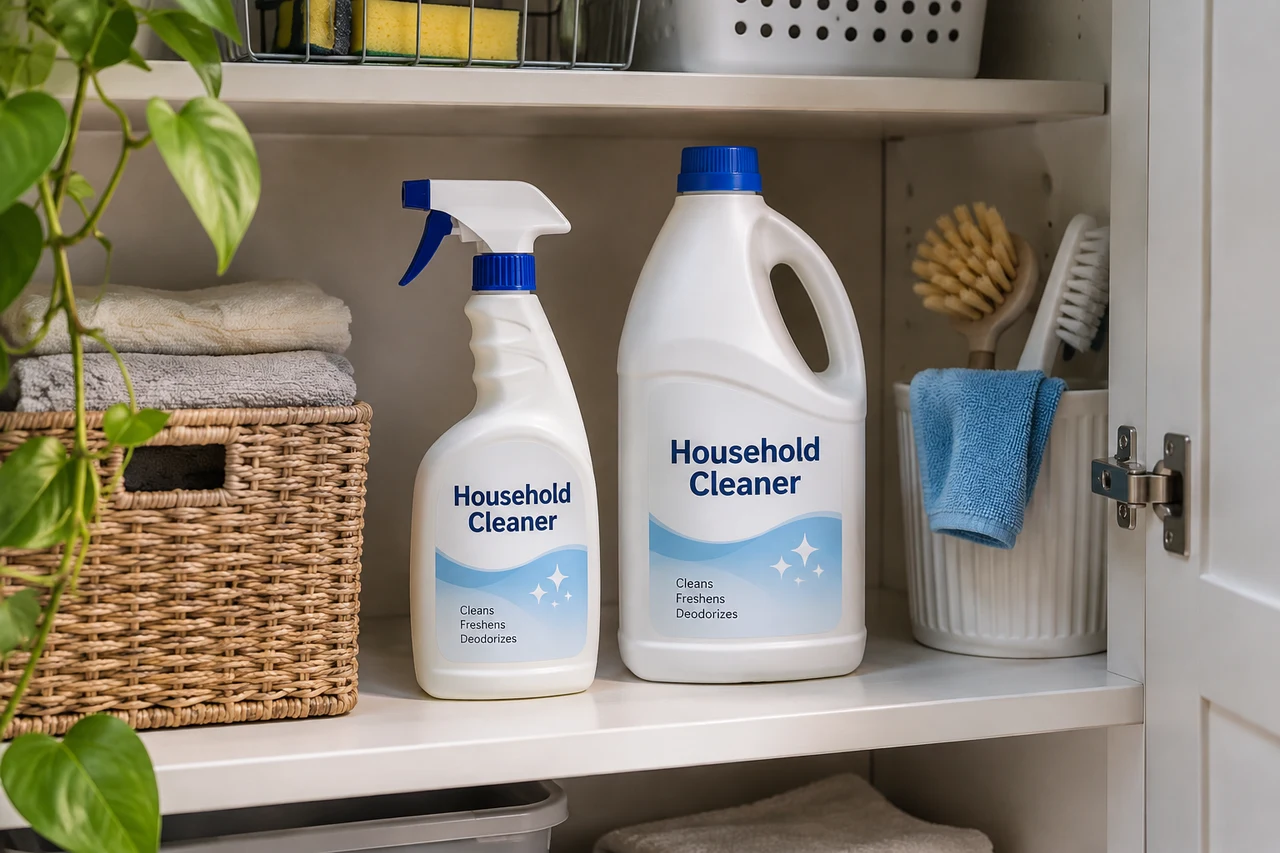
A large refill bottle can look like the economical partner to a spray already in the cupboard. The useful comparison starts before pouring: identify the actual spray, identify the refill and find what the manufacturer says connects them. Two US Clorox Clean-Up SmartLabel records provide a concrete example. Their names are not identical, so neither a shortened brand name nor a familiar bottle shape is a sufficient record.
Fill both sides of the comparison
The 32-fluid-ounce record is titled Clorox Clean-Up All Purpose Cleaner with Bleach, Spray Bottle, Original, with the qualification “Package May Vary.” Its UPC is 044600012049. Preserve the leading zero when recording it. This is the identity of the manufacturer’s returned online record; it is not an inspection of a bottle in somebody’s home.
The corresponding larger record is Clorox Clean-Up Multi-Surface Cleaner with Bleach, Original, Refill, 128 Fluid Ounces, also qualified “Package May Vary.” Its UPC is 044600311227. Record both the refill role and the size. Do not silently replace Multi-Surface in this title with All Purpose to make the two entries look identical.
Both returned general-information panels list EPA Reg. No. 5813-21. Keep that registration field separate from the UPC and the EPA establishment numbers printed nearby. Matching one field does not, by itself, establish which container the manufacturer intends a refill to replenish.
Find the statement that actually connects them
The 128-ounce general-information panel explicitly describes refill use with a 32-fluid-ounce spray bottle, sold separately. It also names filling Clorox Clean-Up All Purpose Cleaner with Bleach. That manufacturer statement provides the connection missing from a comparison based only on brand, fragrance or ingredient names.
This is a bounded relationship between the named records, not permission to refill every Clorox bottle or any empty spray container. The online information does not identify an unknown leftover liquid, establish a different product’s compatibility or prove that a reader’s physical packaging matches these records. A seller’s bundle photograph cannot supply those missing facts.
For a purchase note, the complete result is therefore: “32 fl oz spray, UPC 044600012049; 128 fl oz Original refill, UPC 044600311227; manufacturer explicitly states the named refill use.” Keep the source links with that note instead of retaining only a cropped product image.
Keep directions attached to the identified product
The two retained SmartLabel usage panels include refill directions and a direct-application method specifying five minutes. The generic current product webpage describes a different application sequence and timing. These sources are not being combined into one cleaning recipe or treated as proof that a particular physical label has changed.
Before using the actual product, retain and follow its applicable full directions and warnings; resolve an apparent mismatch with the manufacturer. This comparison supplies no dilution ratio, substitute container or improvised application method. It has not inspected a complete EPA-stamped label or a reader’s bottle.
The refill record’s chemical-hazard warning expressly prohibits mixing it with other household chemicals, including ammonia, toilet-bowl cleaners, rust removers, vinegar or acids, because hazardous gases may result. Identifying a refill relationship never turns combining different remaining products into an acceptable shortcut.
Leave an unidentified existing bottle undecided
In an original fictional example, Maya can read “Clorox” on an old spray but cannot establish its full product name or UPC. She has found the 128-ounce refill record above. Her filled note has a verified online refill identity and an unresolved existing-container identity. It does not have a verified match.
An unsent manufacturer enquiry can read: “I found your Original 128 fl oz refill, UPC 044600311227, and its stated 32 fl oz spray relationship. I cannot establish my existing spray’s exact identity. What identifying information do you need to determine whether it is the intended container?” No support answer or successful refill is implied.
Maya leaves that purchase undecided rather than buying the larger quantity to settle the question later. The useful outcome is a specific supported pair when identities match, or a precise unresolved field when they do not. Neither outcome requires guessing what is inside an old bottle.
Sources & further reading
Published sources for the details and examples discussed in this story.
- Clorox SmartLabel: Original 32 fl oz spray, UPC 044600012049, ingredients and linked usage/general information
- Clorox SmartLabel: Original 128 fl oz refill, UPC 044600311227, intended refill use
- Clorox SmartLabel: 128 fl oz refill usage
- Clorox SmartLabel: 128 fl oz refill health warnings
- Clorox: Current generic Original product page, kept distinct from exact SmartLabel instructions